
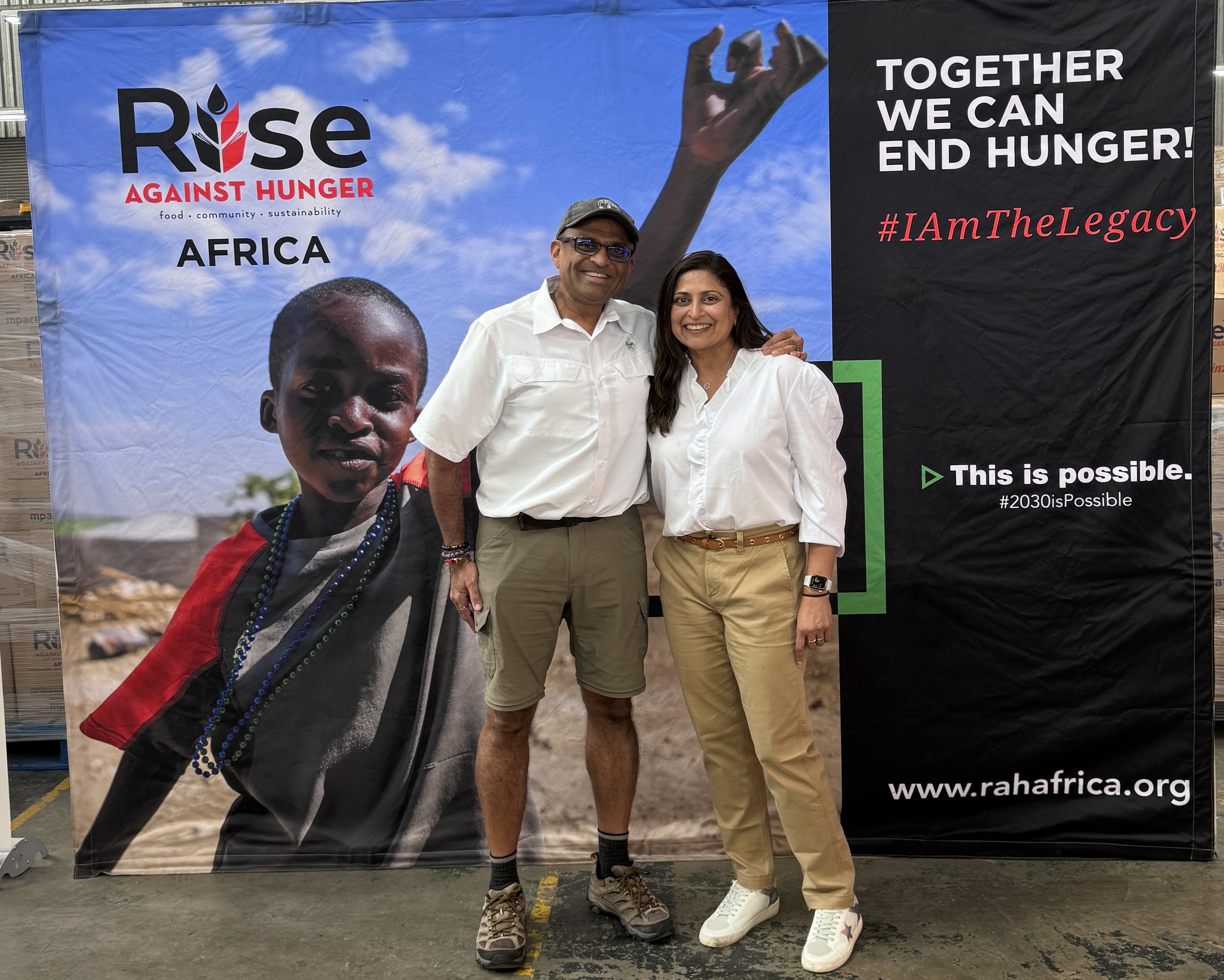
Growing the movement to end hunger is possible — It Starts With a Meal™, and with partnerships like our longstanding work with the Patel family. Since 2016, Rise Against Hunger board member Jay Patel and his family have hosted multiple meal packaging events as a part of their “Unite Our Community” campaign. Over the past seven years, they’ve united thousands of volunteers from the Boys and Girls Scouts, religious groups, civic organizations, corporations, foundations, and most importantly, the communities of the broader Bay Area in California to package more than 820,000 meals, while also raising thousands of dollars in donations. What first began as his son’s Eagle Scout Project has quickly developed into a family goal to package 1 million meals.To see firsthand the impact he’s made possible, Jay and his wife, Nimisha Patel, embarked on a journey to South Africa alongside Rise Against Hunger and Rise Against Hunger Africa in early November 2023. During this impact trip, they visited Early Childhood Development Centers (ECDs) supported by Rise Against Hunger Africa as a part of the ECD Connect Program. This program ensures children between ages 0 and 6 have access to quality education and nutritious meals.Keep reading to learn more about the projects and get a behind-the-scenes look at Jay and Nimisha’s incredible trip to South Africa to see how a partnership with Rise Against Hunger can empower communities and nourish lives.
Day 1: Rise Against Hunger Africa Meal Packaging Event
On the first day of the impact trip, Jay and Nimisha began their journey in Johannesburg, South Africa. While looking forward to the impactful days ahead, they visited Rise Against Hunger Africa’s warehouse, one of our international locations, where they gathered alongside fellow Hunger Champions to package more than 3,000 meals in just one hour. These nutritious meals, which contain 20 essential vitamins and minerals, will provide meals for an entire year up to five times a week for 14 children attending local ECDs. They also learned about the emergency response efforts provided to reach people most affected by disasters across the country by distributing Rise Against Hunger meals and other aid.Jay shares, “It doesn’t take much to make a difference by getting involved with growing the movement to make a tangible difference in our fight against hunger in Africa.”
Day 2: Place of Hope and Lakeside ECD Gardens
After visiting the Rise Against Hunger Africa warehouse, Jay and Nimisha visited two ECD garden projects in Johannesburg, including Place of Hope and Orange Farm Lakeside. Place of Hope is a local community garden dedicated to crop production. They harvest and sell a range of fresh vegetables, such as carrots, onions, spinach, kale, and tomatoes, to the community and donate to nine ECDs. This local garden has also recently added a chicken coop harvesting 300 eggs per day. Orange Farm Lakeside, a local garden located at Langalibalele Dube Primary School, also provides produce to six ECDs in the community and hands-on training to students and parents interested in learning the fundamentals of starting their own garden. Together, these local gardens are improving access to nutrition, leading to food security and self-sufficiency. Jay and Nimisha enjoyed learning more about the gardens from Rise Against Hunger Africa CEO Brian Nell and many program participants.Jay shares, “It Starts with a Meal is how Rise Against Hunger supports so many ECDs in South Africa. But, with the additional programs like farming and chicken coops, financial savings ensure a roadmap to self-sufficiency.”
Day 3: Early Childhood Development Centers
Next up, for the third day of the impact trip, Jay and Nimisha visited two ECDs in Diepsloot: Brightness and Little Stars. As a level two ECD, level four being the highest to become registered by the Department of Basic Education standards, Brightness has 21 learners, where he and the Rise Against Hunger team members were welcomed with warm smiles by the children, principal, and teachers, as they delivered two boxes of Rise Against Hunger meals, groceries and bubbles for the children — and learned more about their center. Little Stars, a partner of Rise Against Hunger Africa since 2010, is a level four ECD made possible by savings generated from donated meals, and they currently serve 58 children. Jay and Nimisha saw firsthand how improving access to quality education and nutritious meals can pave the way toward brighter futures.Jay shares, “The ECD provides a structured environment where the children can develop essential cognitive, emotional, and social skills to succeed in life.”
Day 4: HyHarvest and Hydroponics Projects
Day four led Jay and Nimisha to visit The Place of Joy, a level four ECD, where Rise Against Hunger Africa provided the resources to help this center build an on-site home-grown school garden. While there, Jay and the team planted seedlings of cabbage and beetroot that will be harvested in two to four months and provided to the school and community. They then ventured to learn more about the hydroponics projects. Hydroponic farming is a water-based and nutrient-rich solution for growing crops with no soil where traditional farming is not possible or difficult. During this time, HyHarevest, an implementing partner in South Africa leading the way for this new farming method, taught techniques for harvesting lettuce, tomato, basil, and herbs. In addition, local communities send representatives to learn these farming methods to leverage these skills in their respective communities.Jay shares, “From traditional farming to Hydroponic farming, Rise Against Hunger and its partnerships with various organizations work together to train community members to intern with experts and then build their own farms in their local communities. Seeing firsthand how the ECD achieves self-sufficiency with trained experts is amazing!”
Day 5: A Day to Explore South Africa
Lastly, as Jay and Nimisha reflected on their experience of the impact trip and how the week-long journey highlighted the four pathways to end hunger — nourishing lives, responding to emergencies, empowering communities, and growing the movement — they joined Rise Against Hunger and Rise Against Hunger Africa to experience South Africa’s rich history and culture, including a visit to the Cradle of Humankind Museum, a non-predatory game safari tour and local cuisine. Patel shares, “As we continue toward our goal of packaging 1 million meals by uniting our communities, we know and will share with our volunteers how each meal creates a chain reaction in helping end world hunger and building self-sufficiency. The impossible is possible with determination, commitment, and love!” Are you interested in growing the movement to end hunger? Host a meal packaging event with Rise Against Hunger by filling out this form here to learn more today.